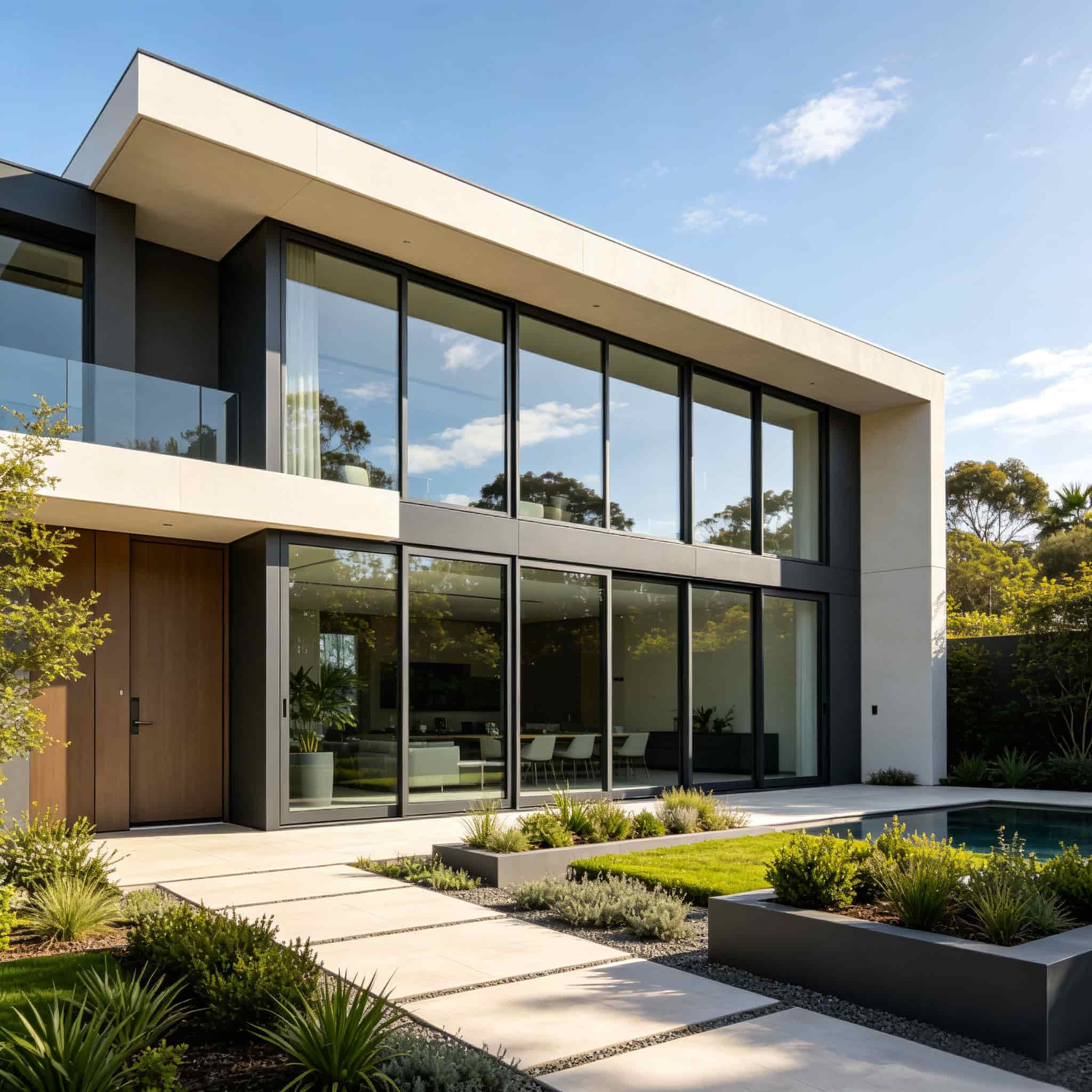
Why a “system window” and not an assembled window?
An assembled window is a sum of parts: bought-in profiles, matched hardware and glass, each compliant on its own — but the complete window may not be. A system window is defined by its architecture: profile chambers, thermal break position, gasket compression, hardware load points and glazing rebate all follow one design logic. The critical concept is isotherm alignment — placing the thermal resistance centre-lines of profile, break and spacer on the same vertical plane so heat cannot short-circuit.
Three questions expose a real system window: is there a whole-window type test report? Are the thermal break and sealing system original matched components? At maximum sash size, do hardware load points match the profile wall thickness?
Why it sells: four quantifiable reasons
- Compliance is now a gate, not a bonus. The EU EPBD pushes new buildings toward near-zero energy; England & Wales Part L (2021) applies a 1.2 W/(m²·K) limiting U-value for windows in new dwellings plus whole-building primary energy targets; North America applies ENERGY STAR climate-zone U-factors (commonly 0.27–0.32 Btu/h·ft²·°F) and NAFS performance grades.
- Margin comes from customisation, not specification. Non-standard sizes, shaped openings, oversized panels and custom colours/woodgrain finishes cannot be price-compared on marketplaces.
- Risk is transferable. Whole-window certification plus Factory Production Control (FPC) and full technical documentation give the main contractor defensible evidence at handover.
- Life-cycle cost wins the decision. Coating life, hardware cycles and air-tightness retention determine 20-year operating cost; premium clients buy on LCC, not unit price.
From concept to commercial argument
A premium custom window factory does not sell aluminium; it sells three deliverable packages: a performance package (measured U-value, SHGC, air/water/wind ratings, acoustic Rw), a compliance package (CE + DoP, NFRC label, AS 2047 report, Passive House component certification where applicable) and a delivery package (shop drawings, tooling, export packing and container loading rates, on-site technical briefing). What the buyer really pays for is not having to carry the performance risk themselves.
FAQ
Q: What is the difference between a thermal-break system window and a standard thermal-break window?
A standard thermal-break window is assembled from generic profiles with unverified interaction between break position, gasket compression and hardware load points, usually backed by individual component tests only. A system window is designed, tested and certified as a complete unit, supplying whole-window U-value, air/water/wind class and operating-cycle results supported by factory production control.
Q: Which certifications are required to export windows to Europe or North America?
The EU requires CE marking with a Declaration of Performance to EN 14351-1. North America requires NFRC energy ratings, ENERGY STAR by climate zone and NAFS performance grade (AAMA/WDMA/CSA 101/I.S.2/A440); Canada adds CSA A440S1. Australia requires compliance with AS 2047 and typically WERS energy rating. Always verify against the latest local code for the project location.
Q: What is the typical MOQ and lead time for custom windows?
Typical minimums are 50–200 m² or 30–50 units per project, depending on whether new tooling is required. Non-tooled custom orders run 30–45 days; new extrusion tooling adds to 60–75 days, plus 25–40 days sea freight. Confirm against factory capacity and project complexity.
Q: Which matters more, whole-window U-value or glass U-value?
Always specify whole-window U-value (Uw). Frame and edge-of-glass linear heat loss (Psi-value) can degrade real performance substantially. A well-engineered system keeps frame Uf at 1.4–2.0 W/(m²·K) through multi-chamber profiles, wider polyamide breaks, warm-edge spacers and isotherm alignment, closing the gap between centre-of-glass and whole-window figures.